Lyophilizer YR07072
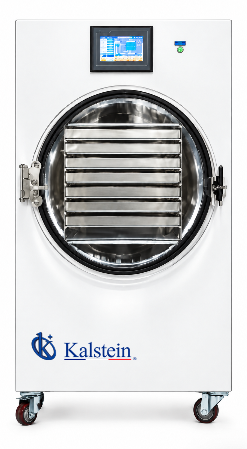
Lyophilization removes water from the frozen product through sublimation: ice goes directly to vapor under vacuum. The equipment offers a cold trap temperature of −55 °C and a final vacuum of less than 2 Pa. Its PLC system allows for the configuration of parameters such as temperature, time, and vacuum; it also includes preset processes, fault diagnostics, and protections to help control the cycle. The transparent door allows observation of the process, and the automated operation starts with a button. The actual capacity of each batch depends on the food, its water content, the thickness of the pieces, and how they are distributed on the trays.
This page provides an overview of the Vacuum Lyophilizer for Food from 30 to 40 kg YR07072, including selection criteria, investment factors, operational advantages and maintenance recommendations. The aim is to support an informed decision before requesting a quotation.
This Kalstein model is available for laboratories across Latin America, Europe, Africa, the Middle East and Asia, with selection criteria adapted to the diversity of local purchasing, installation and support conditions in each region.
Key factors to consider
Before selecting the Vacuum Lyophilizer for Food from 30 to 40 kg YR07072, confirm workflow, available space, required accessories and installation conditions. This prevents oversizing the purchase and helps prepare a more accurate quotation.
In a small food plant, the operator distributes the prepared product over the eight trays, selects a standard program or adjusts the parameters according to the food, and starts the cycle. The PLC control supervises the process under vacuum, while the cold trap captures the extracted moisture. At the end, the lyophilized product can be packaged in suitable containers to protect it from ambient moisture. The equipment can be integrated into the production of ingredients for soups, lyophilized fruits and vegetables, instant mixes, or specialty products. Before producing on a commercial scale, it is advisable to validate the result with test batches, as the load, thickness of the pieces, and moisture content influence the cycle.
Across these markets, evaluation should consider varied local contexts such as international laboratory procurement spanning Latin America, Europe, Africa, the Middle East and Asia and match the product to the real workload of the laboratory in each country.
Market price range
The price of a commercial food lyophilizer depends on capacity, tray area, cold trap temperature, controls, origin, and included services. As a reference, equipment is available for capacities close to 30–40 kg per batch starting from approximately US$8,400 to US$24,000 in international offers. In Europe, some models of 30–40 kg are listed at approximately €28,950 to €36,750 , before taxes, transport, and installation. These values correspond to different equipment and configurations; they do not represent the quoted price of the YR07072. To know the price of the YR07072 with the appropriate shipping and electrical supply conditions, you can request a quote from the Kalstein team or generate an automatic quote through the Kalstein Plus platform.
The final price may vary according to configuration, accessories, logistics, warranty and territorial availability. Compare the technical sheet with the real laboratory workload before confirming the investment.
Budget comparison varies by country and should include the regulatory requirements specific to each market, the electrical conditions of each region, accessories, logistics and after-sales support.
Value for money
Equipment value depends on operational stability, required accuracy, ease of maintenance and accessory availability.
Value for money should be reviewed together with equipment stability, after-sales support, technical documentation and expected service life. A well-matched selection reduces downtime and improves return on investment.
Advantages and disadvantages
In a small food plant, the operator distributes the prepared product over the eight trays, selects a standard program or adjusts the parameters according to the food, and starts the cycle. The PLC control supervises the process under vacuum, while the cold trap captures the extracted moisture. At the end, the lyophilized product can be packaged in suitable containers to protect it from ambient moisture. The equipment can be integrated into the production of ingredients for soups, lyophilized fruits and vegetables, instant mixes, or specialty products. Before producing on a commercial scale, it is advisable to validate the result with test batches, as the load, thickness of the pieces, and moisture content influence the cycle.
Main advantages include specialized application, integration with laboratory routines and accessory configuration. Limitations may include installation requirements, user training and preventive maintenance to preserve performance.
Expected lifespan based on use and maintenance
Install the lyophilizer on a firm surface, with space for ventilation, service access, and movement of packaging. Before connecting it, confirm that the voltage and frequency of the electrical network match the requested configuration. Follow the manual instructions for loading the trays and cleaning the chamber, and record the parameters of each product to reproduce cycles that yield good results. At the end of each process, clean and dry the surfaces according to the manufacturer's instructions, check the seals, and maintain the vacuum system in proper conditions. To preserve the quality of the product, use containers with a good moisture barrier and define storage according to the processed food.
Service life depends on usage frequency, cleaning, storage, calibration when applicable and adherence to technical recommendations. A structured maintenance plan helps preserve accuracy, safety and operational continuity.
A support and spare-parts network deployed across Latin America, Europe, Africa, the Middle East and Asia helps preserve service continuity and plan preventive maintenance without extended downtime.
Specifications table for the Lyophilizer YR07072
Lyophilizer YR07072
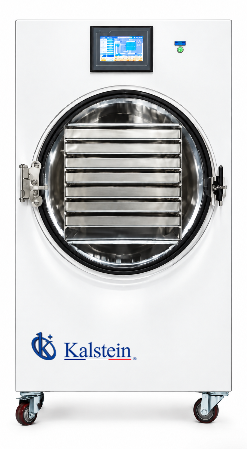
Lyophilization removes water from the frozen product through sublimation: ice goes directly to vapor under vacuum. The equipment offers a cold trap temperature of −55 °C and a final vacuum of less than 2 Pa. Its PLC system allows for the configuration of parameters such as temperature, time, and vacuum; it also includes preset processes, fault diagnostics, and protections to help control the cycle. The transparent door allows observation of the process, and the automated operation starts with a button.
The actual capacity of each batch depends on the food, its water content, the thickness of the pieces, and how they are distributed on the trays. The data also indicates a water collection of 40 kg/24 h; this figure describes the moisture collection capacity and should not be confused with the processing capacity of 40–42 kg per batch.
Market Price
The price of a commercial food lyophilizer depends on capacity, tray area, cold trap temperature, controls, origin, and included services. As a reference, equipment is available for capacities close to 30–40 kg per batch starting from approximately US$8,400 to US$24,000 in international offers. In Europe, some models of 30–40 kg are listed at approximately €28,950 to €36,750, before taxes, transport, and installation. These values correspond to different equipment and configurations; they do not represent the quoted price of the YR07072.
To know the price of the YR07072 with the appropriate shipping and electrical supply conditions, you can request a quote from the Kalstein team or generate an automatic quote through the Kalstein Plus platform.
Frequently Asked Questions
What processing capacity does the YR07072 have?
The technical sheet indicates a capacity of 40–42 kg per batch. The processable amount may vary depending on the type and preparation of the food.
What foods can be lyophilized?
It can be used with vegetables, aquatic products, meats, seasonings, instant beverages, and prepared foods, among other products compatible with lyophilization.
Does the machine automatically configure the entire process?
The equipment has a PLC system, one-button start, and preset standard processes. It also allows for customizing temperature, time, and vacuum curves according to the product's needs.
What electrical supply does it need?
The indicated configuration is 220 V / 50 Hz. The sheet states that it can be customized to 110 V or 380 V; it is advisable to confirm the available voltage before placing the order.
Advantages and Considerations
Among its advantages are its lyophilization area of 3 m², the eight trays, automation via PLC, and the ability to adjust the process. The transparent door facilitates observation of the cycle, while fault diagnostics and protection functions help monitor operation and prevent accidental parameter changes.
As aspects to consider, the equipment requires an electrical installation compatible with a power of 4,500 W and sufficient space for its dimensions and weight. The net weight is 335 kg and the gross packaged weight reaches 439 kg. Additionally, the cycle duration and final result depend on each food and may require testing to define the appropriate load and parameters.
Product Use in the Field
In a small food plant, the operator distributes the prepared product over the eight trays, selects a standard program or adjusts the parameters according to the food, and starts the cycle. The PLC control supervises the process under vacuum, while the cold trap captures the extracted moisture. At the end, the lyophilized product can be packaged in suitable containers to protect it from ambient moisture.
The equipment can be integrated into the production of ingredients for soups, lyophilized fruits and vegetables, instant mixes, or specialty products. Before producing on a commercial scale, it is advisable to validate the result with test batches, as the load, thickness of the pieces, and moisture content influence the cycle.
Recommendations
Install the lyophilizer on a firm surface, with space for ventilation, service access, and movement of packaging. Before connecting it, confirm that the voltage and frequency of the electrical network match the requested configuration. Follow the manual instructions for loading the trays and cleaning the chamber, and record the parameters of each product to reproduce cycles that yield good results.
At the end of each process, clean and dry the surfaces according to the manufacturer's instructions, check the seals, and maintain the vacuum system in proper conditions. To preserve the quality of the product, use containers with a good moisture barrier and define storage according to the processed food.
| Model | YR07072 |
|---|---|
| Processing Capacity | 40–42 kg per batch |
| Lyophilization Area | 3 m² |
| Cold Trap Temperature | −55 °C |
| Final Vacuum | < 2 Pa |
| Tray Size | 420 × 898 mm |
| Number of Trays | 8 |
| Tray Spacing | 45 mm |
| Pumping Speed | 6 L/s |
| Water Collection Capacity | 40 kg/24 h |
| Noise Level | ≤ 60 dB |
| Electrical Supply | 220 V / 50 Hz; customizable options of 110 V or 380 V |
| Total Power | 4,500 W |
| Equipment Dimensions | 82.7 × 110 × 135 cm |
| Net Weight | 335 kg |
| Packaging Dimensions | 94 × 129 × 150 cm |
| Gross Weight with Packaging | 439 kg |
Products related to model YR07072
Industrial freeze dryer for food 300 kg YR07036
Ver producto
Silicone Oil Heating Lyophilizer 2㎡ YR07024
Ver producto
Freeze Dryer YR06692
Ver producto
100 kg Commercial Vacuum Freeze Dryer YR06647
Ver producto
Large capacity 500kg vacuum freeze dryer YR06612
Ver producto
Electric Heating Vacuum Freeze Dryer YR06637
Ver producto
Silicone Oil Heating Lyophilizer YR05985-1 - YR05985-2
Ver producto
Vertical Electric Heating Laboratory Freeze Dryer YR05198 // YR05201
Ver productoFrequently Asked Questions about the Lyophilizer YR07072
What processing capacity does the YR07072 have?
The technical sheet indicates a capacity of 40–42 kg per batch. The processable amount may vary depending on the type and preparation of the food.
What foods can be lyophilized?
It can be used with vegetables, aquatic products, meats, seasonings, instant beverages, and prepared foods, among other products compatible with lyophilization.
Does the machine automatically configure the entire process?
The equipment has a PLC system, one-button start, and preset standard processes. It also allows for customizing temperature, time, and vacuum curves according to the product's needs.
What electrical supply does it need?
The indicated configuration is 220 V / 50 Hz. The sheet states that it can be customized to 110 V or 380 V; it is advisable to confirm the available voltage before placing the order.
How do I choose the right Lyophilizer YR07072 for my laboratory?
Selection should start from workload, critical technical parameters, available space and frequency of use. Kalstein can support the comparison between operational needs, budget and maintenance requirements to avoid choosing equipment that is oversized or insufficient.
What should I review before requesting a quotation?
Review the model, technical specifications, required accessories, electrical conditions, consumables, delivery timing and installation needs. With this information, the quotation can be prepared more accurately and aligned with the laboratory workflow.
Does Kalstein provide guidance for this type of equipment?
Yes. The commercial and technical team can support product evaluation, explain differences between models, answer application questions and advise on preventive maintenance, spare parts and documentation required for a secure purchase.
What maintenance helps extend the equipment lifespan?
Follow the manufacturer manual, perform regular cleaning, verify calibrations or controls when applicable, avoid workload abuse and keep maintenance records. Stable use and preventive routines reduce failures and improve operational continuity.