
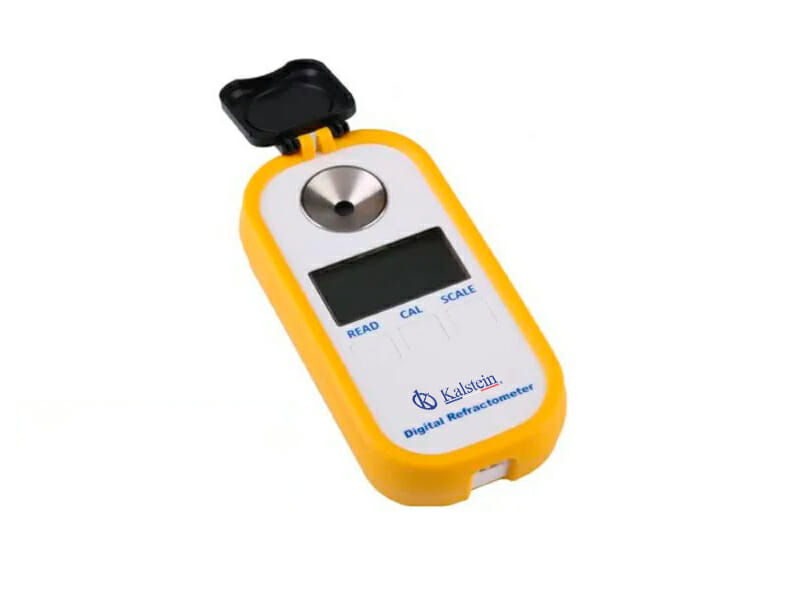
Product Description
The Salinity Digital Refractometer is an essential tool designed for precise measurement of salinity levels across various solutions. These devices are vital in industries ranging from food and beverage to marine biology, providing accurate data essential for quality control and research. Models such as the **YR05953** and **YR05954** offer different ranges and measurement units to suit specific needs, ensuring flexibility and versatility.
Equipped with Automatic Temperature Compensation (ATC), these refractometers adjust seamlessly to fluctuations in temperature, maintaining measurement precision. The models feature a broad range of applications with varying specifications to cater to diverse assessment requirements, from salinity and specific gravity to chlorinity and refractive index measurements.
| Model | Description | Measurement Range | Min. Div. | Accuracy | ATC | ATC Temp. |
| YR05953 | Salinity | 0.0–28.0% | 0.10% | ±0.1% | Yes | 0-40°C |
| YR05954 | Salinity | 0–280‰ | 1‰ | ±1‰ | Yes | 0-40°C |
| YR05955 | Specific gravity | 1.000-1.217 | 0.001 | ±0.002 | Yes | 0-40°C |
| YR05956 | Refractive Index | 1.3330–1.3900nD | 0.0001nD | ±0.0003nD | Yes | 0-40°C |
| YR05957 | Salinity | 0—100‰ | 1‰ | ±2‰ | Yes | 0-40°C |
| YR05958 | Chlorinity | 0–57‰ | 1‰ | ±2‰ | Yes | 0-40°C |
| YR05959 | Specific gravity | 1.000-1.070 | 0.001 | ±0.002 | Yes | 0-40°C |
| YR05960 | Refractive Index | 1.3330–1.3530nD | 0.0001nD | ±0.0003nD | Yes | 0-40°C |
These features make the Salinity Digital Refractometer a crucial instrument, enabling scientists and professionals to measure saline solution properties with remarkable precision. If you need more information or wish to obtain a quotation, consider exploring the Kalstein Plus platform for seamless purchase experiences.
Market Price
The market price range for digital refractometers tends to vary based on model specifications and additional features such as automatic temperature compensation. On average, you can expect these devices to range from $200 to $630, ensuring that there is a model to fit your budget and technical requirements. It’s essential to weigh these costs against the long-term benefits that precise measurements can yield in your specific field of work.
Frequently Asked Questions
What is the purpose of a digital refractometer?
A digital refractometer is used to measure the refractive index of liquids. This measurement is a quick and reliable method for determining the concentration of dissolved substances, such as salt in water, allowing for precise quality control and research applications.
How does Automatic Temperature Compensation (ATC) benefit measurements?
ATC ensures that the measurements remain accurate regardless of temperature fluctuations, making the refractometer suitable for diverse environments without losing reliability. This feature is particularly useful in applications where temperature control is challenging.
Can this refractometer measure other properties besides salinity?
Yes, depending on the model, these refractometers can measure specific gravity, chlorinity, and refractive index, providing a comprehensive tool for various analytical needs.
Advantages and Disadvantages
Advantages:
These devices offer precise measurement capabilities with a quick and easy-to-use interface, adapting effortlessly to varying environmental temperatures due to their ATC feature. They are lightweight and portable, making them convenient for field applications.
Disadvantages:
The initial investment might be considerable depending on the model chosen. Refractometers require careful maintenance to ensure longevity and proper calibration to maintain accuracy over time.
Use in the Field
In practical scenarios, digital refractometers are indispensable in fields like marine biology, where monitoring salinity levels in water samples is crucial. In food production, particularly in the dairy and beverage industries, these devices ensure that product concentrations meet industry standards. Their portability and ease of use make them ideal for on-the-spot testing and quality control checks outside the lab.
Recommendations
To maximize the utility of your Salinity Digital Refractometer, regular calibration against known standards is recommended. Keep the lens and prism surfaces clean to ensure unobstructed light paths, which are crucial for accurate readings. Always store the refractometer in a protective case to prevent damage from impacts or environmental exposure.
If you’re searching for a blend of innovation and quality, you’ve come to the right place. At Kalstein, we offer you the luxury of exploring our exclusive catalog of laboratory equipment. We manufacture each device with a high level of excellence. Our intuitive and efficient online purchasing channels are designed for your convenience, ensuring the most friendly prices. Don’t hesitate any longer; we bring science to life, and it’s time to become part of our community. https://kalstein.net/en/product/salinity-digital-refractometer-yr05953-yr05960/.
