
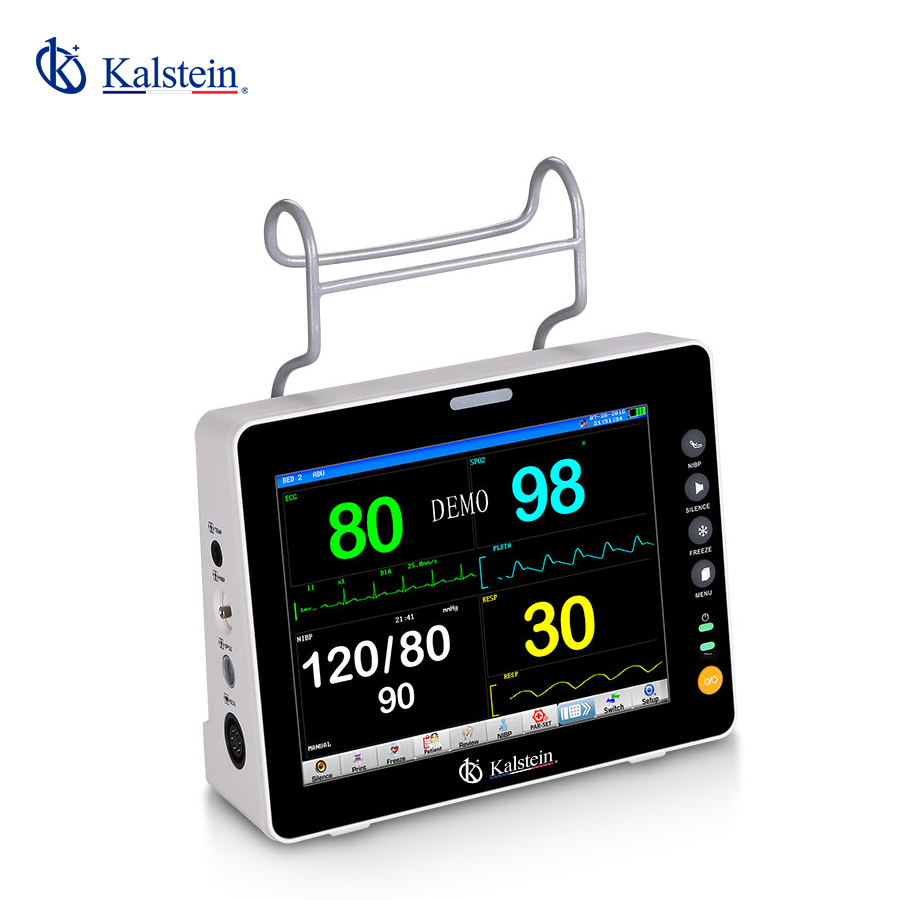
Product Description
Kalstein’s advanced patient monitors, models YR02170, YR02171, and YR02172, stand at the forefront of medical technology. These monitors are meticulously designed to deliver accurate, real-time patient data, catering to the rigorous demands of modern healthcare environments. Central to their operation is a robust ECG system, featuring a 5-lead mode (RA, LA, LL, RL, V) with a connection method of I, II, III, AVR, AVL, AVF, V, allowing for diverse monitoring configurations. The devices offer enhanced ECG accuracy with a sensitivity greater than 200(uVp-p) and a differential input impedance of ≥5MΩ, ensuring precise cardiac assessments.
The heart rate monitoring capabilities of these devices span a comprehensive range, offering measurements from 0 to 350 bpm for model YR02170, and from 20 to 300 bpm for models YR02171 and YR02172. Each monitor integrates a sophisticated respiration measurement method, utilizing impedance between R-F (RA-LL), which provides vital respiratory data with accuracy and reliability. Additionally, the inclusion of a non-invasive blood pressure (NIBP) system with manual, auto, and stat monitoring modes further accentuates the versatility of these monitors, accommodating various clinical needs efficiently.
| Specification | YR02170 | YR02171 | YR02172 | |
|---|---|---|---|---|
| ECG | Lead mode | 5 Leads(RA,LA,LL,RL,V) | ||
| Connection method | I, II, III, AVR, AVL, AVF, V | |||
| Lead Mode | 3 Leads (RA,LA,LL) | |||
| Waveform | 1ch | |||
| Gain | x250, x500, x1000, x2000 | |||
| HR Range | Adult: 15~300bpm | |||
| Neo/Ped | 15~350bpm | |||
| Accuracy | ±1% or ±1bpm | |||
| Resolution | 1bpm | |||
| Sensitivity | >200(uVp-p) | |||
| Differential input impedance | ≥5MΩ | |||
| ST segment Monitoring Range (Measure Range) | -2.0~+2.0mV | |||
| ST segment Monitoring Range (Measure Accuracy) | -0.8mV~+0.8mV | |||
| Heart Rate (Measuring range) | 0~350bpm | 20~300bpm | ||
| Heart Rate (Accuracy) | ±1bpm | |||
| Respiration | Method | Impedance between R-F(RA-LL) | ||
| Differential Input Impedance | >2.5MΩ | |||
| Measuring Impedance Range | 0.3~3.0 MΩ | |||
| Base line Impedance Range | 200~4000Ω | |||
| Bandwidth | 0.1~2.5Hz | |||
| Resp. Rate | Adult: 2~120BrPM | |||
| Neo/Ped | 2~150BrPM | 0~150BrPM | ||
| Resolution | 1 BrPM | |||
| Accuracy | ±2 BrPM | |||
| Alarm | 10~40S | |||
| NIBP | Method | Oscillometric | ||
| Mode | Manual/Auto/STAT | |||
| Measuring Interval in AUTO Mode | 1,2,3,4,5,10,15,30,60,90,120,180,240,480(Min) | |||
| Measuring Period in STAT Mode | 5 Min | |||
| Pulse Rate Range | 40~240bpm | |||
| Alarm Type | SYS, DIA, MEAN | |||
| Resolution | ||||
| Pressure | 1mmHg | |||
| Accuracy | Maximum Mean error: 5mmHg | |||
| Maximum Standard deviation | 8mmHg | |||
| SPO2 | Display | Number of SPO2, waveform of capacity, Pulse | ||
| Measuring range | 0~100% | |||
| Resolution | 1% | |||
| Accuracy | 70~100% (±2%) | |||
| Alarm system | Audio-video alarm | |||
| Pulse rate range | 0~300bpm | |||
| TEMP | Channel | 2 | ||
| Measuring and Alarm Range | 0~50ºC | |||
| Resolution | 0.1ºC | |||
| Accuracy | 0.1ºC | |||
| Actualization interval | about 1 Second. | |||
| Average Time Constant | <10 Second. | |||
Market Price
The patient monitors YR02170, YR02171, and YR02172 are competitively priced in the market. Generally, these monitors are available within a price range of approximately 900 USD to 1,700 USD, reflecting the advanced technology and reliable performance they offer. This range offers healthcare facilities an affordable yet high-quality option for patient monitoring, making it viable for both small clinics and large hospitals. Due to their competitive pricing, these monitors are a smart investment for institutions looking to enhance patient care without exceeding budget constraints.
Frequently Asked Questions
Are these monitors suitable for pediatric use?
Yes, the monitors feature adjustable heart rate measurement ranges and other settings to accommodate pediatric and neonatal patients effectively.
What kind of maintenance do these monitors require?
Regular cleaning and calibration checks are recommended to maintain optimal performance. Detailed maintenance protocols are included in the user manual.
Can these monitors integrate with existing systems in a hospital setup?
Absolutely, these monitors are designed to integrate seamlessly with most hospital systems through standard connection interfaces and settings.
Advantages and Disadvantages
Advantages: These patient monitors offer a host of benefits, including high accuracy, multiple modes of operation, and comprehensive monitoring capabilities which are critical in various clinical settings. Their design ensures ease of use and adaptability, making them suitable for diverse patient populations. Moreover, they provide detailed and accurate data that enhance diagnostic precision and patient care.
Disadvantages: One potential limitation is the requirement for regular maintenance and calibration, which is common with high-precision medical devices. Additionally, while the monitors are user-friendly, initial training may be necessary for staff to utilize all advanced features effectively.
Product Use in the Field
In practical settings, Kalstein’s patient monitors are invaluable tools within emergency rooms, intensive care units, and during surgical procedures. They provide continuous, real-time data that aids clinicians in making swift, informed decisions concerning patient care. Their versatile configurations support a wide range of clinical environments, ensuring that medical professionals have immediate access to vital signs and diagnostic data, thereby improving the responsiveness of medical care.
These monitors are also beneficial in outpatient settings, such as clinics where regular monitoring can assist in managing chronic conditions or evaluating patient recovery after surgical procedures. Their portability and ease of setup enhance their usability in varied healthcare scenarios, contributing significantly to patient management and monitoring strategies.
Recommendations
To maximize the utility of these patient monitors, healthcare facilities should ensure that staff are well-trained to operate them efficiently. Regular calibration and maintenance checks will help sustain the accuracy and longevity of these devices. Additionally, integrating these monitors into electronic medical record systems could further streamline patient data management.
Facilities should also consider establishing protocols for routine data review and system updates, ensuring that the monitors function optimally and in sync with other medical equipment. By adopting these best practices, healthcare providers can ensure that these patient monitors deliver the utmost efficiency and accuracy, ultimately enhancing patient outcomes.
If you are looking for a blend of innovation and quality, you’ve come to the right place. At Kalstein, we offer you the luxury of exploring our exclusive catalog of laboratory equipment. Each piece is crafted with a level of excellence, and our intuitive and agile online purchase channels are designed for your convenience, ensuring the most friendly prices. Don’t wait any longer, we bring science to life, and it’s time for you to become part of our community. https://kalstein.net/en/product/patient-monitors-yr02170-yr02171-yr02172/.
