
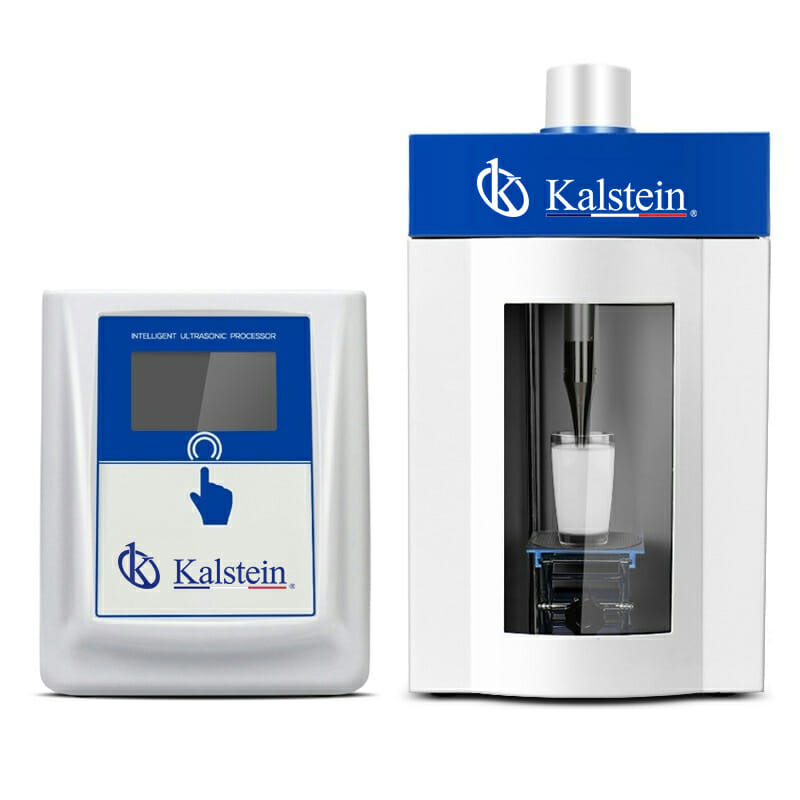
Product Description
The ultrasonic homogenizers YR05832, YR05833, and YR05834 by Kalstein are advanced devices designed to provide precision and efficiency in laboratory processes. These models operate at an ultrasonic frequency range of 20-25 KHz, ensuring optimal homogenization for a variety of materials. The YR05832 model delivers a maximum power of 650W, while the YR05833 and YR05834 models offer 900W and 1000W respectively. This variable power range allows for customization depending on the application requirements, making these homogenizers suitable for various scientific fields.
One of the standout features of these homogenizers is their range of optional variable amplitude levers, with the YR05832 accommodating sizes from 2 mm to 12 mm, and the YR05834 extending to 15 mm. In terms of capacity, they handle volumes from 0.2 to 500 ml, 0.2 to 600 ml, and 0.2 to 800 ml, respectively. Another key feature is the electricity supply compatibility with both 220V and 110V, ensuring versatility for different lab setups. Notably, the YR05833 model includes temperature control, a crucial component for sensitive materials.
| Models | YR05832 | YR05833 | YR05834 |
| Ultrasonic Frequency(KHZ) | 20-25 | ||
| Maximum Power(W) | 650 | 900 | 1000 |
| Optional Variable Amplitude Lever(φ) mm | 2,3,6,10,12 | 2,3,6,10,12,15 | 2,3,8,10,12,15 |
| Included with | 6 | 10 | 15 |
| Capacity | 0.2-500 | 0.2-600 | 0.2-800 |
| Electricity Supply (V) | 220/110 | ||
| Temperature Control | NO | YES | NO |
Market Price
The market price of ultrasonic homogenizers can vary significantly based on their specifications and capabilities. Typically, models like the YR05832, with a maximum power of 650W, start at a price range of $2,000 to $3,000. On the other hand, more powerful models such as the YR05834, which offers up to 1000W, can range from $4,000 to $5,000. These variations in pricing reflect the added features and capacities that each model offers, allowing laboratories to choose based on their specific needs and budget constraints.
Frequently Asked Questions
What are the main differences between the YR05832, YR05833, and YR05834 models?
The primary differences lie in their power capabilities, capacity, and additional features such as temperature control in the YR05833 model.
Can these homogenizers be used for sensitive materials?
Yes, particularly the YR05833 model is ideal for sensitive materials due to its temperature control feature which helps prevent overheating during the process.
Are the devices easy to install and operate?
Yes, the ultrasonic homogenizers by Kalstein are user-friendly, with a straightforward installation process and operational guidelines designed to facilitate ease of use.
Advantages and Disadvantages
One of the major advantages of Kalstein’s ultrasonic homogenizers is their adaptability across different laboratory environments, thanks to their variable power settings and amplitude options. The inclusion of temperature control in the YR05833 model enhances this adaptability by allowing delicate samples to be processed. Furthermore, their compatibility with universal electricity supplies (220/110V) makes them versatile for global use.
However, there are a few considerations to note. While the YR05833 model includes temperature regulation, the YR05832 and YR05834 models do not, which could limit their application for temperature-sensitive procedures. Additionally, while the range of amplitude levers allows for customization, setting these parameters might require additional training or calibration time to optimize results.
Field Usage
In the field, these ultrasonic homogenizers are invaluable for their efficiency in sample preparation such as homogenizing, emulsifying, dispersing, and cell disruption. They find applications in pharmaceutical laboratories for mixing compounds, in biochemical research for breaking down cellular structures, and in food industries for creating stable emulsions. The precision of ultrasonic homogenizers makes them indispensable tools where consistent and repeatable results are critical.
Practically, their usage involves placing the sample in a suitable container, inserting the sonotrode, and selecting the appropriate settings for frequency, power, and time. The ultrasonic waves then generate intense shearing forces that mix or disrupt the sample at a microscopic level, ensuring uniformity and consistency.
Recommendations
To maximize the effectiveness and longevity of your ultrasonic homogenizer, regular maintenance is essential. This includes cleaning the sonotrode after every use to prevent sample cross-contamination and ensuring the device is calibrated according to the manufacturer’s guidelines. It is advisable to periodically check and service the unit to ensure it runs efficiently.
Proper training on the use and handling of the device can significantly enhance its performance and help maintain its reliability over time. Additionally, for processes requiring precise temperature conditions, opting for a model with temperature control is recommended.
Looking for a blend of innovation and quality? You’ve come to the right place. At Kalstein, we offer you the luxury of exploring our exclusive catalog of laboratory equipment. We manufacture each piece of equipment with a high level of excellence. Our intuitive and agile online purchase channels are designed for your convenience, ensuring the best price points available. Don’t hesitate any longer; we bring science to life, and it’s time for you to be a part of our community. https://kalstein.net/en/product/ultrasonic-homogenizer-yr05832-yr05836/
